If you’re as much of a TV enthusiast as I am, then you must be aware of the Emmys. No they aren’t just a bunch of me (my family used to call me Emmy baby when I was young). As one of my all time favorite TV characters beautifully put it, her favorite season is, Awards season. There are the Oscars, Golden Globes, SAG Awards, BAFTAs, and of course the Emmys. I personally love autumn, but that’s neither here nor there. The Emmys are a rather perfunctory ceremony where they try to recognize outstanding television, and when they get it right, they really get it right. In 2024, an Emmy winning show dropped right into our laps, or rather the laps of Hulu, Disney+ streamers and FX watchers. It was full of intrigue and tradition, a true celebration of feudal Japan. Any show that has history, complex plots, and a bit of action never ceases to grab my attention. Over a 10 episode arc, a beautiful story set in the dawn of the Edo period of Japan, and smack dab in the middle of the Shogunate period, (which is the end of the 16th century and beginning of the 17th), unfurls to display the complexities of the world of shoguns.
The shogunate period of Japan was feudal, at times brutal, and delicately balanced in tradition and globalization. It was impossible to not be part of the world order at this time, but the inherent skepticism of outsiders allowed Japan to focus on internal cultural and economic growth in this time period. Of course, outside influences snuck their way on to the island, in the form of religious salvation and missions. Cue the procession of Catholics and Protestants from Spain, Portugal, and Britain. At this time, these countries were in a mad dash to explore, convert, and conquer as much land and as many people as they possibly could, remember Columbus and Magellan, well these were their descendants, captivated by the power of finders keepers. Aside from similarities with schoolyard children, they were armed with muskets, cannons, and a dogmatic belief in their own cultural superiority that made them dangerous playmates indeed in the delicate political landscape of feudal Japan.
Unfortunately or fortunately, depending on your view of social media addiction, I am easily influenced by the media that I consume. I’ve been listening to non-stop Greek music because I’ve been researching for my upcoming trip to Greece, I’ve been reading more books set in the regency period because I accidentally started and finished another series set in the regency era, my art is leaning towards midcentury modern because I’m rewatching Madmen, and now my food leans more into the land of Nippon because I’ve been watching Shogun. My love of Japanese cuisine is not novel, but I go through periods of intense fascination with one topic or another, I would like to call it a form of ADHD hyper-fixation, but I’m self-diagnosed so I guess I can call it what I want.
There’s a restaurant in Seattle that I frequent only for celebratory reasons. It’s been a setting for many a birthday and graduation dinners. I’m assuming you’re able to predict the cuisine because you have a certain level of comprehension to have gotten this far into my spiel, it is Japanese. It has all the quintessential elements of Japanese cuisine, served to you in an environment that feels like you were invited to someone’s house for dinner. It’s warm, with light wood Japanese interior design accents, funky, soft art, and clean, simple lines. The food is unfussy and yet still upscale. It is called, Nishino.
The head chef and brains behind Nishino, is Chef Tatsu Nishino, formerly of Kyoto Japan. His success in Seattle stretches across decades, his innovation still surprises, and the poise and quiet luxury of Nippon lives in his food. Back in 2005, he wrote a tasting menu, titled autumn omakase, after already a decade of feeding the Seattle people. The introduction is clearly written by the same hands that created Nishino’s iconic menu, and it was such a pleasure consuming yet another type of his creative endeavor. His words never skip an opportunity to cherish and honor his homeland, just as his food celebrates the centuries of tradition in every Japanese dish. Sure, Nishino does not boast the most traditional menu, but to quote the chef,
“…American diversity and lifestyle in general [was] more relaxed than back in Japan. It had more ‘freedom, more space.’ And when it came to cooking, people were more accepting of different techniques.”
This embrace of American diversity and reverence of Japanese cuisine, birthed dishes of foie gras and seared tuna with shiitake mushroom and red wine soy reduction and kampachi usuzukuri which is thinly sliced kampachi with ponzu sauce, topped with fried garlic and jalapeño slices. But one of my favorites and a permanent fixture on Nishino’s menu is the, tara saikyoyaki, Miso Black Cod. Nishino isn’t the first place I tried miso black cod, but it is the place I’ve eaten it the most. This restaurant and dish evokes a sense of time passing, of tradition, of celebration woven into the fabric of everyday life.
So long story short, miso black cod has and will forever be on my “must have” list. It’s been a dish I have never forgotten, and never thought to create. It felt too special. Like how could I just make it on any random Tuesday evening for dinner? But funnily enough, that’s exactly what I did. One Tuesday evening, I tried my hand at the sumptuous, flaky, umami dish of miso black cod.
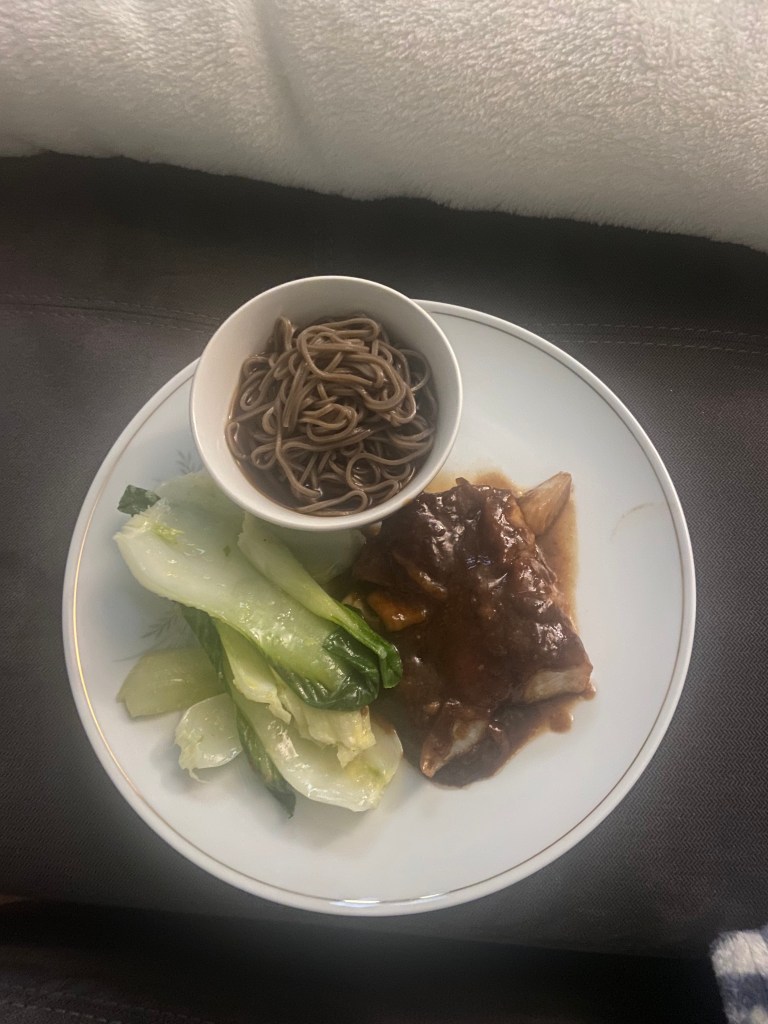
I was gifted a New York Times Cooking subscription for Christmas, and I have definitely put it to good use, cooking dishes and using flavors that tickle my curiosities and push my creativity. Inspired by the show, I was drawn to make something from the land of the rising sun, so I created Miso Black Cod, Soba, & Bok Choy, or at least a variation of said dish. The recipe I used for this miso black cod, is from the kitchen of the notorious Nobu Matsuhisa, once Nishino’s boss; it would be a coincidence if I believed in coincidences, I prefer the fates.
The ingredients are rather simple, as long as you source local and fresh. I suppose simple isn’t the right word, minimal fits better. The key to these ingredients obviously being a pristine fillet of cod. I’m not saying the other ingredients aren’t important, but I think the chefs I mentioned above would agree with me on this, the fish is of utmost import.
The miso marinade doesn’t just flavor the fish, it transforms it completely. There’s a certain amount of depth due really, almost entirely to the miso paste. There’s something almost alchemical about how this ancient ingredient turns a mild white fish into something so rich and complex that it rivals the most decadent Western dishes.
When I finally gathered my courage to attempt this at home, I was surprised by how straightforward the process actually is. The marinade requires just four ingredients, white miso paste, mirin, sake, and sugar. But the magic happens during the marination period, at least 24 hours, though Nobu recommends two to three days for optimal flavor penetration. The patience required feels distinctly Japanese, a culture that has elevated waiting and careful timing to an art form.
The cooking itself is almost anticlimactic after such meticulous preparation. A quick pat dry, a gentle broil, and suddenly my kitchen is filled with an aroma that instantly transports me back to the dining room of Nishino. The caramelization of the miso creates this golden crust that gives way to the buttery flesh beneath. It’s a textural juxtaposition that’s simply divine.
To accompany the fish, I blanched some bokchoy and whipped together a cold soba noodle side. Bokchoy might seem like a simple side, but its preparation requires precision too. Blanch it too long and it becomes mushy; too little and the stems remain unpleasantly crunchy. The perfect bokchoy has bright green leaves that wilt just so, while the stems maintain a slight crispness. For the carby part of this dish, I made soba. It’s traditionally served cold in summer and warm in winter, however, I’m partial to the cold noodle preparation. Proper soba is cooked just until al dente, then rinsed thoroughly in cold water to remove excess starch and to halt the cooking process. This washing also gives the noodles that distinctly clean, slightly slippery texture that allows them to slide perfectly into the dipping sauce and down your gullet. I followed the steps in this other New York Times Cooking recipe, for Soba Noodles. The soba noodles are pretty straightforward if you can read instructions, but the cold dipping sauce that goes with it has a bit more behind it. The dipping sauce, tsuyu, is another universe of flavor. Made from dashi (a stock typically made from kombu seaweed and bonito flakes), soy sauce, and mirin, it’s the soul mate to cold soba. When dashi is called for in any recipe, I always make it from scratch. Over the years, I’ve learned to bulk up my cabinets with staple ingredients I know I will use for future dishes, for this, that would be sea kelp and bonito flakes. It helps when the ingredients are dried and can be stored for longer than a refrigerated items shelf-life. You can read more about dashi in my blog post, Dashi-ng Edification.
There is something deeply satisfying about recreating a dish that carries such cultural weight. When I took that first bite of homemade miso black cod, I was tasting not just dinner, but a lineage of chefs who’ve perfected this preparation over generations. From the traditional izakayas of Kyoto to Nobu’s global empire, all the way to Chef Nishino’s Seattle haven, and now to my humble kitchen on a Tuesday night, there’s a thread connecting us all.
As I watched Shogun unfold its tale of political intrigue and cultural clash, chopsticks poised over my plate of homemade miso black cod and cold soba, I can’t help but feel a deeper connection to what I’m watching. When done correctly and respectfully, food can be such a direct pathway to understanding other cultures. I can read about history, I can watch television shows, but there’s something uniquely intimate about preparing and consuming the dishes that have sustained a civilization for centuries.
So yes, I may be easily influenced by the media I consume, Greek music due to pre-trip research, regency romance novels stacked by my bedside, midcentury modern sketches piling up in my notebooks, but there’s something beautiful about letting art direct my curiosity. Sometimes the most authentic experiences come from these impulsive diversions, these moments when I allow myself to be led by fascination rather than expertise.
And if that means more Tuesday nights with miso black cod, bokchoy, and soba, well… I can think of far worse fates.
 Edible Memoir
Leave a comment