I believe I’ve mentioned the local grocery, Metropolitan Market, in my Steak Dinner article. The grocery store is bougie and pricey, but every once in a while, I love to splurge on one of their dessert. Years ago, at a time that no longer exists in my memory, I randomly bought one of their bread puddings, made in house, that was orange flavored with a boozy lil’ sauce that would change my dessert worldview forever. I feel like I have a finite amount of space in my brain to remember truly remarkable moments in my life, and despite how silly it sounds, this bread pudding experience claimed one of those precious memory slots.
The first time I tasted this orange-infused, brandy-soaked marvel, I had one of those cartoon moments where the character’s eyes pop out of their head. It was that good. The texture, which I’d always imagined would be soggy and unpleasant, was instead this beautiful contrast of crisp, caramelized edges and a custardy center that melted on my tongue. The balance of sweet and bitter orange zest cut through any cloying sweetness, and the boozy sauce added complexity that most desserts lack. Booze would unsurprisingly become a staple ingredient in most of my desserts from that point on.
I sat on my sofa unable to comprehend the movie I was just watching moments before, experiencing what I can only describe as a spiritual awakening. Had bread pudding always been this good? Had I dismissed an entire category of dessert without proper investigation? What else had I been wrong about? (Spoiler: I was not wrong about fondant. Fondant is still the devil’s play-doh).
Now, I should probably explain something important about myself, I’m not much of a dessert person. Actually, I’m of the strong opinion that one should never start or end their day with something sweet. If I do have a dessert, I have to nibble on something savory afterward just to get that uncomfortable sugary feel off the top of my tongue.
When I tell people I’m not a “dessert person,” they look at me like I’ve just admitted to hating puppies or sunshine. The horror! The disbelief! “But what about chocolate?” they’ll ask. Yes, I appreciate a square of dark chocolate occasionally, preferably something so bitter it makes your face pucker slightly. But those towering cakes, those sticky-sweet confections that leave your teeth feeling like they’re wearing fuzzy sweaters? Hard pass.
It’s not that I don’t appreciate the artistry of desserts or the momentary bliss they provide. It’s more that I’ve developed a complicated relationship with sugar that borders on suspicion.
My anti-dessert stance is further complicated by the fact that I was once a proud card-carrying member of the Sweet Tooth Society. I used to love dessert, I used to love sweets. Root-beer floats were my absolute favorite, and if I was allowed to order a Shirley Temple, it had to be with a literal bowl of maraschino cherries on the side. My childhood self would be appalled at what I’ve become.
Something shifted in my teenage years, and I began gravitating toward saltier shores. My hormones were all out of whack, and I’m pretty sure my body went through one of the 7 year hormone cycles that alternative eastern medicine has been trying to edify us for literal centuries. I feel like I might have been ahead of the curve with the changing tastebuds, but I was pretty ahead of the curve for a handful of things, let’s just say high school was absolutely no picnic.
I’m not sure when or why we as people decided to specialize sugar in a format fit for aprés-dinner, but we did and I’m not a big fan. I feel like one should indulge at any point of the day, actually I prefer to have my sugar crash in the middle of the day when I can power through it semi-productively instead of lying awake at two in the morning contemplating the universe because I had tiramisu after dinner (Tiramisu is another of my favorites, but I have not attempted making it yet). And if I’m going to subject myself to a sugar crash, it damn well better be worth it. I suppose it has something to do with sweets and desserts being either difficult or expensive to make, but in an age where we can access sugary treats at every dollar point, I strongly disagree with this continued after dinner sugar consumption tradition.
Disregarding everything I just said about my complicated relationship with dessert, after sampling the bougie grocery store’s bread pudding, I can honestly say its one of my absolute favorite desserts (aside from a Basque Cheesecake I have yet to attempt to make on my own, I have very fortunately only had this cheesecake made for me, but I will be attempting it in the near future, so keep your eye out for that written experience, oh yeah and the Tiramisu from the paragraph, above, oh and how could I forget about Panna Cotta!).
Bread pudding was honestly never something I thought I would enjoy, let alone boldly state that it’s my favorite dessert. I can honestly say I didn’t quite understand bread pudding conceptually, it doesn’t seem possible, how could bread be pudding? And how could the texture be appetizing even in the least? But I was so clearly wrong about all of my many assumptions.
This dessert somehow bypassed all my usual dessert objections. It wasn’t one-dimensionally sweet. It had texture. It had nuance. It had alcohol (which would unsurprisingly become a staple ingredient in most of my desserts from that point on). Honestly, it probably helped that bread pudding originated as a way to use stale bread, appealing to my love of resourceful cooking and hatred of food waste. There’s something delightfully unpretentious about transforming day-old bread into something spectacular.
When I could no longer justify the expense of store-bought bread pudding, I embarked on a mission to recreate it at home. This became my white whale, my Everest. I scoured cookbooks and food blogs, combining elements from different recipes, tweaking and adjusting until I finally created something that not only matched but, dare I say, surpassed the original.
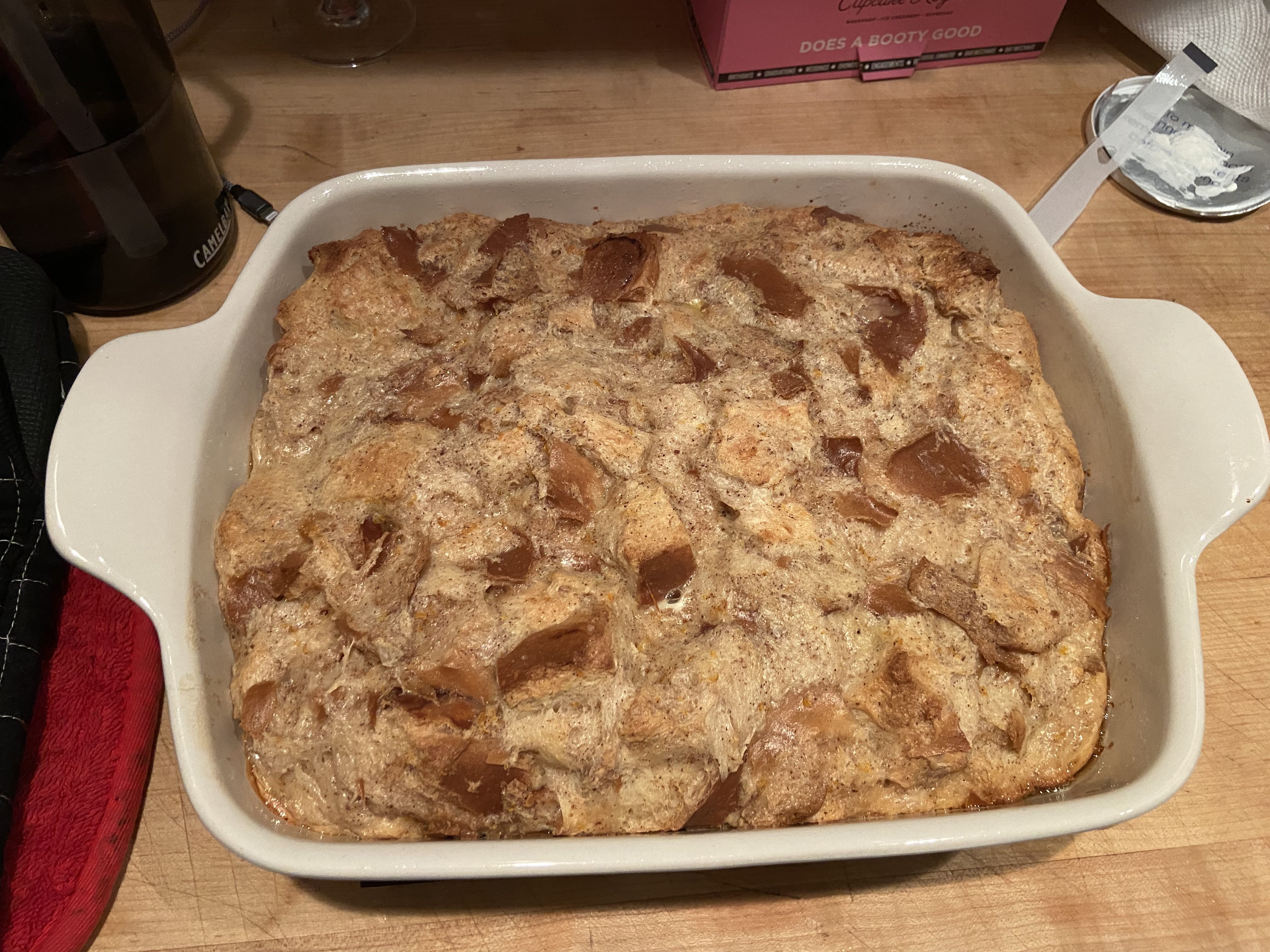
Not just any bread will do. You need something with substance, with character. Challah or brioche provide the perfect foundation, rich enough to stand up to the custard but not so dense that they become leaden. Day-old is essential because fresh bread turns to mush. The secret is restraint with the sugar and generosity with the aromatics. Too many bread puddings are cloyingly sweet without enough dimension. Mine celebrates the orange zest, warming spices, and that magical boozy sauce that transforms a good dessert into a truly transcendent one.
What I’ve come to realize through my bread pudding journey is that dessert doesn’t have to play by the rules. Who says it has to be sickeningly sweet? Who says it can only be enjoyed after dinner? Some of my favorite bread pudding experiences have been for breakfast (it’s basically French toast’s sophisticated cousin) or as an afternoon snack with a cup of coffee to balance the sweetness. In fact, I’ve started a personal campaign to liberate dessert from its after-dinner prison. Had a rough morning? Have a slice of bread pudding at 10am. Want something sweet with your lunch? Go for it. Life is too short to save pleasure for the end of the meal.
This philosophy extends beyond bread pudding, of course. I’ve become more open-minded about desserts in general, though I still maintain my high standards. If I’m going to consume sugar, it has to be worth it, complex, interesting, well-crafted. No mindless cookie consumption or settling for mediocre birthday cakes. I’ve become a dessert connoisseur, albeit a highly selective one.
Without further ado, here’s my recreation of the Metropolitan Market orange, spice, and everything nice bread pudding:
Edible Elements
- 5-6 cups of bread, day old preferably, Challah or brioche
- 2-3 eggs
- pinch of salt
- 1/3 cup or less of sugar
- 2 cups of milk or half and half
- 2 tablespoons of butter and more to schemer in pan
- 1 tablespoon of vanilla extract
- the zest of 1-2 oranges
- 1/4 teaspoon of nutmeg
- 1/2 teaspoon of cinnamon, you can use cinnamon sticks
- 1/4 teaspoon of cardamom
- 1/4 teaspoon of anise, you can add whole anise to infuse instead
Cut and cube the bread. And collect all of your ingredients.
In a sauce pan, slowly heat and infuse the milk or half and half with sugar, salt, vanilla extract, and the aromatics of the zest of oranges, nutmeg, and cardamom until the kitchen smells like a boulangerie. Let the infused milk mixture cool slightly. This is crucial, unless you want scrambled eggs in your bread pudding, which I’m guessing you don’t. In a buttered casserole or lasagna dish, mix together the bread cubes, cooled milk concoction, and eggs. I choose to mix it directly in the baking dish because there is literally no point in dirtying up a bowl just to combine ingredients. I have better things to do than wash unnecessary dishes, like literally anything else. Make sure all the bread cubes are coated and then you’re set. Some people let this sit for 30 minutes to soak, but if you’re using day-old bread, it should absorb the liquid fairly quickly. If you’re using extra-stale bread, giving it a bit more time to soak isn’t the worst idea.
Preheat oven to 350 and bake for 30-45 minutes, until the tops of the bread bits are browned and the center is set but still slightly jiggly.
Sauce Edible Elements
- 1 cup of half and half
- 1/2 cup or less of sugar
- Juice of 1-2 oranges
- Pinch of cinnamon, nutmeg, cardamom
- 1 tablespoon of cornstarch
- A splash or two of brandy!
While the bread pudding is baking, make the sauce. In the same saucepan as before (because I’m sure you’re noticing I don’t like using an unholy amount of dishes just to be subjected to cleaning said dishes later), combine half and half, sugar, orange juice, spices, and cornstarch. Whisk constantly over medium heat until it thickens, think glue! Not Elmer’s, more like a nice, pourable school paste.
Take the sauce off heat and add brandy, however much or little you want. No judgment here, some days call for more brandy than others. The alcohol will cook off slightly, leaving behind that complex flavor that makes this sauce so special.
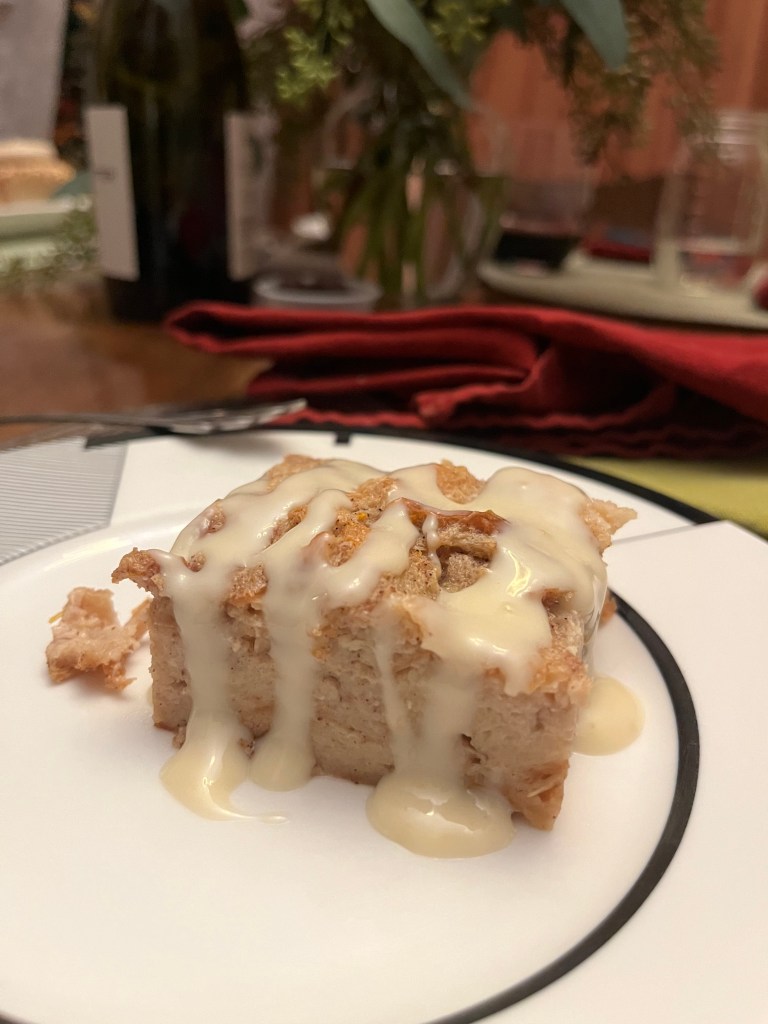
When the bread pudding comes out of the oven, let it cool for just a few minutes before serving. Ladle the warm sauce over individual portions, or pour it over the entire dish if you’re feeling generous.
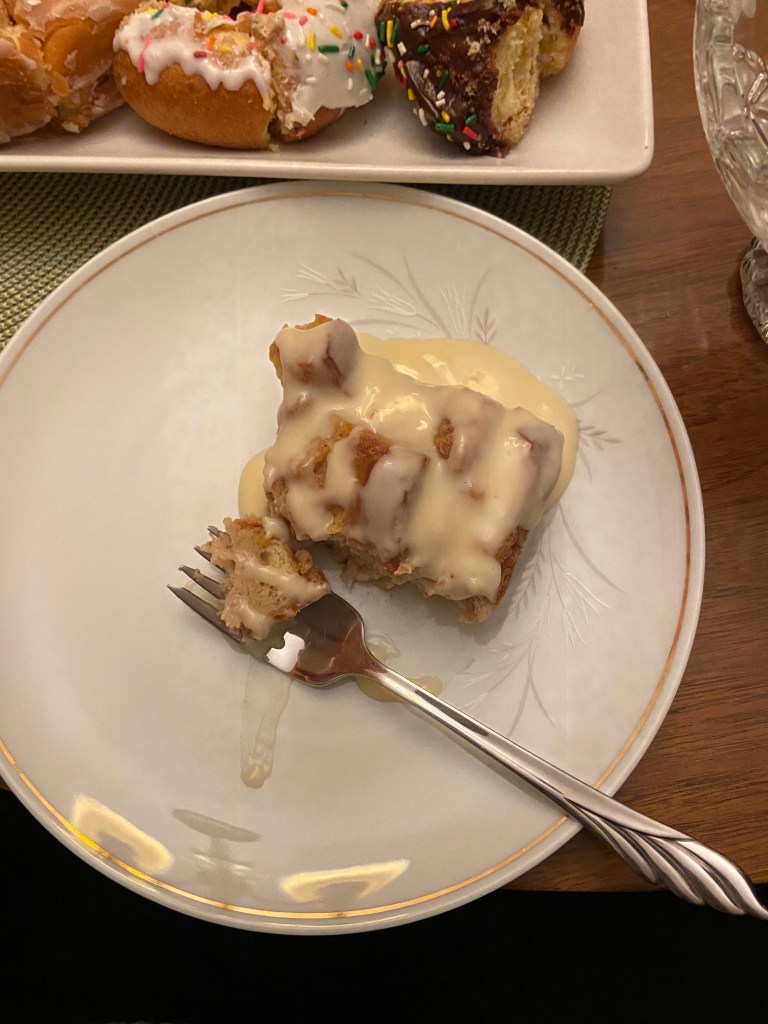
So here I am, a self-proclaimed dessert skeptic who now makes bread pudding for my own birthday. Life is full of contradictions, isn’t it? I still maintain that most desserts aren’t worth the calories or the sugar crash, but I’ve learned never to say never. There’s always an exception that proves the rule.
For me, that dessert is this orange-infused, brandy-soaked bread pudding. It’s not just about the flavors, though those are exceptional. It’s about the transformation, how something as humble as stale bread can become something so luxurious. Maybe that’s why it resonates with me. In a world of flashy, over-the-top desserts screaming for attention, bread pudding quietly proves that basic when done right, can be the most profound form of deliciousness.
And if that’s not a metaphor for life, I don’t know what is.
Recipes that inspired mine:
NYT Cooking, https://cooking.nytimes.com/recipes/1012636-simple-bread-pudding
Orange Spice, delicious living, https://www.deliciousliving.com/recipe/orange-spiced-bread-pudding-0/
Brandy Bread Pudding Sauce, https://marleysmenu.com/brandy-sauce-for-bread-pudding/
(I am not affiliated with the aforementioned website, brand, or recipe)
 Edible Memoir
Leave a comment