When I was young, I had an aunt that would religiously leave a tin full of biscotti at our front door. Altruism as a whole is widely practiced in my culture. The tin would be empty inside a week. It wasn’t until recent years, that I began to understand the magical partnership between biscotti and coffee, hush-hush, doughnuts are blissfully unaware of the deceit.
Biscotti is a naturally hard, crunchy cookie, ideal for dunking into a steaming, hot cup of Giò, although you could also eat the cookie as dessert. Scotti is literally just “cookie” in Italian, so Unscotti is a cookie baked once, and Biscotti is a cookie baked twice. It’s a versatile little Italian cookie. Dessert or breakfast, this cookie hits that sweet spot; it is essentially a cookie after all. Or eat it as a snack, no one is judging you. In this edible chapter, I will explicate the process of cookies baked once, twice, the assorted flavors you can impart within each, and the varying ways you can decorate and alter the appearance of your finished Italian masterpiece. But first, just as everything else, we have to start from its conception.
The etymology of Biscotii sports Latin roots and ancient Roman origins. Biscotti has fed the masses for literal centuries. First created in ancient Rome to feed their expansive Legions traversing around the empire, pillaging, aiding, fighting, and whatnot, biscotti has come quite a long way to take up real estate on your dessert plate or to partner with your coffee in the morning. Pliny the Elder is rumored to have said that biscotti would be edible for centuries due to its hardy nature and perhaps he understood it would become a classic and literally endure the ages.
Grammar Tip: As I have many times been corrected by Italian Americans, biscotti is commonly mispronounced “bi-skat-ee” and the correct pronunciation is actually “bi-skot-ee”. If you encounter any proud Italians with a particular fondness for linguistics, remember I gave you fair warning and proper, prior rectifications.
Conceived in the dawn of the covid crisis, my biscotti batches were mixed and moulded specifically for my Nana’s covid blues. (Nana means “grandma” in Chamorro) She finds creature comforts in dipping a biscotti, or two, or three into her coffee on a daily basis. She drinks coffee in the morning, in between smoke breaks, before gardening, after gardening, while playing solitaire, right before bed, as a midnight snack, and every time in between. Caffeine doesn’t affect her as it does us average Giòs. She possesses a kind of divinely imparted immunity for the stuff. Addiction, smichten. My nana drinks coffee like it’s water; she bleeds that bitter, brown elixir of the covfefe gods. Her ride or die pairing has always been doughnuts, but every time my aunt would leave a tin of biscotti at the doorstep, biscotti would take the front row. Biscotti dipped in coffee is a meal of champions, literal Roman champions. One could fuel a legion with this stuff or at least curb my Nana’s appetite until lunch.
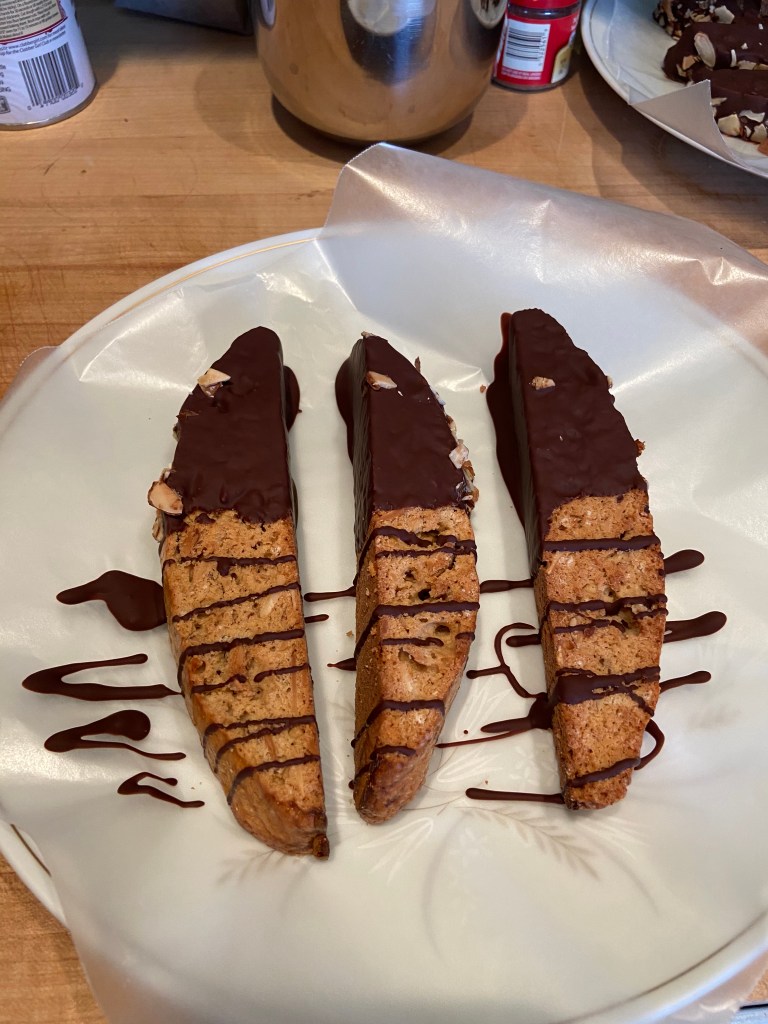
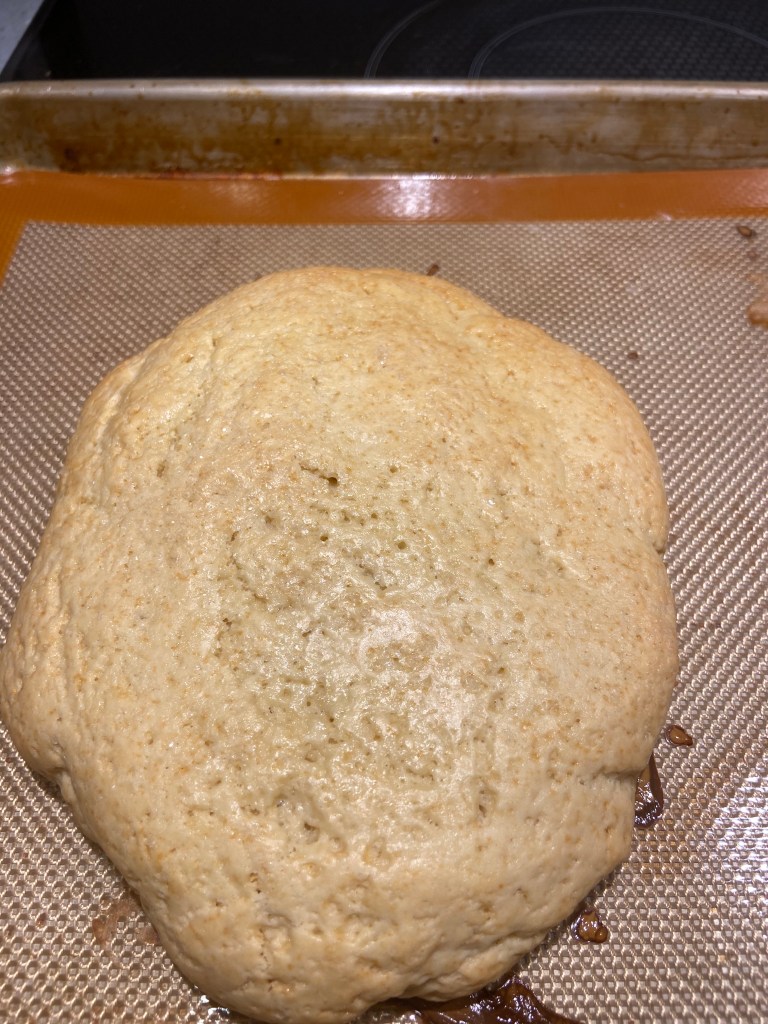
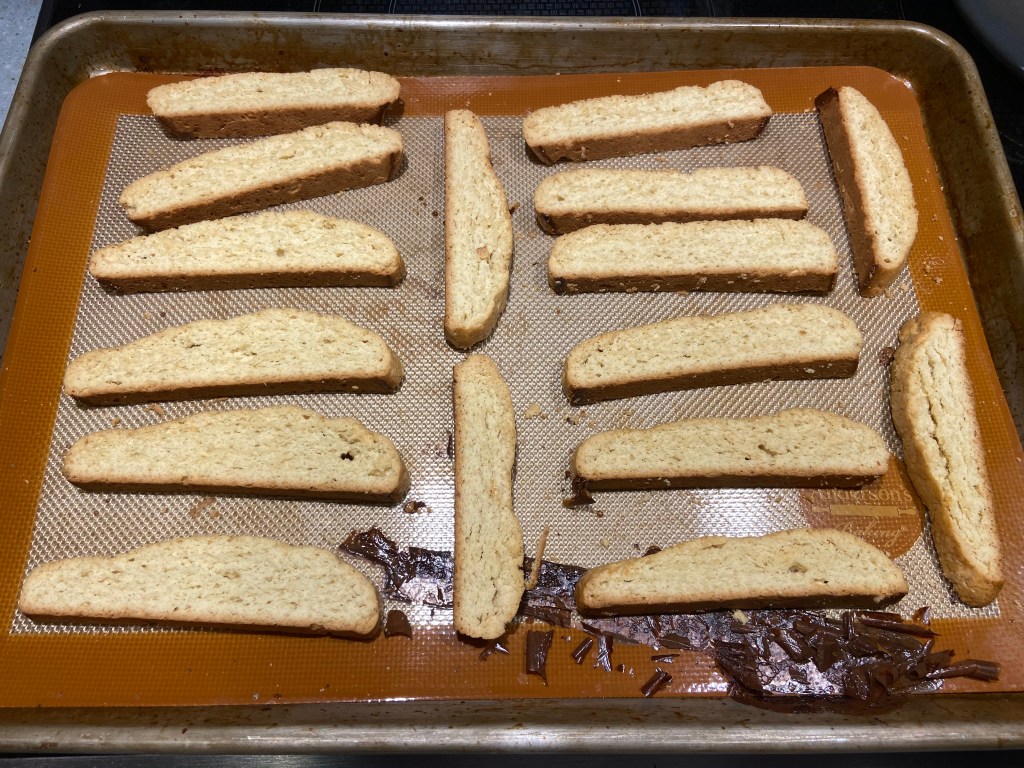
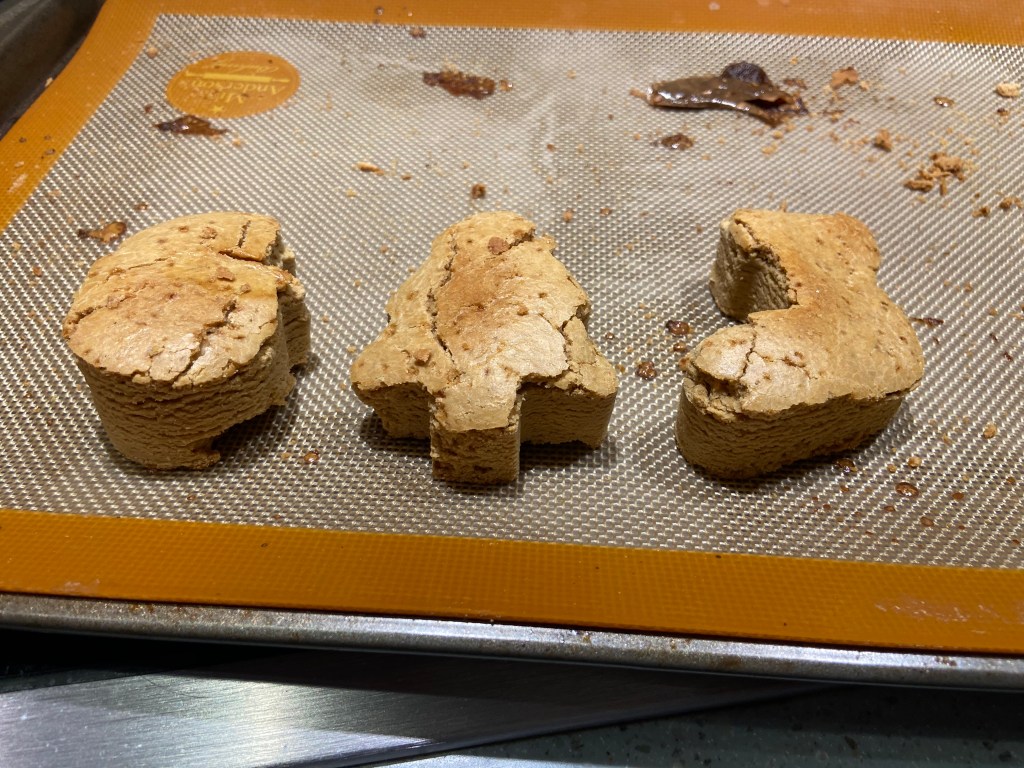
The few photos of biscotti before the evidence was eaten. I’ve heard that many perceive baking biscotti as a grueling and time-consuming process, however, I’ve been lucky to say I haven’t experienced said woes. I tried many, probably too many, biscotti recipes and finally found my perfect cookie. And now for the duration of the pandemic and beyond, I’ve baked a batch of biscotti sometimes once a month or sometimes once a week. It’s not unusual to spot the cookie jar on the counter filled with those tasty little Italian cookies. Baking biscotti has since become my baking therapy recipe allowing me a moment of mindlessness to meditate and create. My methods, techniques, and materials have improved since the first biscotti batch proving that once again, practice makes perfect. I love to share my bakes with others as I don’t have much of a sweet tooth, which makes all that practice a further labour of love. I didn’t choose the biscotti to be that to me, the cookie chose me.
A brief biscotti poetry hiatus, here lies an epigram —
From Rome’s grand feast to café’s hum,
Italians crunch where worlds are from.
Biscotti, twice-baked, old yet spry,
A timeless taste no time can buy.
The following recipe is inspired and adapted from King Arthur Baking Company’s American-Style Vanilla Biscotti (I am not affiliated with the aforementioned website, brand, or recipe).
Preheat the oven to 350°F or about 177°C for all my global epicures. Line a baking sheet with parchment paper, wax paper, or my favorite, a silicone baking mat. Or I suppose, you could not line a baking sheet, do what you want. Place the baking sheet aside, that’s for later.
In a large bowl and hand-held mixer (or in a stand-mixer’s attached bowl, if you’re one of the lucky ones to own such a contraption), cream the butter, sugar, salt, vanilla extract, and baking powder. Add one gradually or pour them all in at the same time, it doesn’t really affect the end result. The butter needs to be soft so take the stick out of the refrigerator and let it sit at room temperature until it’s soft enough to poke with your finger. Or you could slightly melt the butter in the microwave, but if you melt it too much it will change the texture of the finished product, so melt with care.
Add the sugar amount I use listed below, or you could add or subtract more sugar, I’m not your math teacher, you may have free will over the numbers. My taste leans more to the savory, salty, and spicy universe, and when it comes to desserts or really anything sweet, I appreciate just a tinge of sweetness not a whole bucket.
Sugar-less Warning: I omit a bit, okay a lot, of the sugar from the original recipe. I feel as if most recipes were not cater-made for my tastebuds, isn’t that odd, not everyone in the world knows about my sugar intolerance. I better check that my axis is still spinning and all y’all are still orbiting around me.
Sprinkle in a pinch of salt, keep in mind if you’ve creamed salted or unsalted butter earlier, manage the amount of salt you add accordingly.
Vanilla extract and baking powder is added next and then continue to cream the mixture until full incorporation. Cream the mixture until you can’t see granules of sugar or salt, we don’t want anything grainy. On the flip side, don’t over cream the mixture, you don’t want anything over whipped. The cream in the butter will begin to separate and become grainy. The butter lives in a pendulum, find the middle. Not to mention, if you over-mix the butter, the resulting cookie could turn out tougher than it should or needs to be. Light, careful, and precise handwork is required when creaming butter and other elements.
Add the eggs to the creamed mixture. Mix until it’s properly gloopy and almost vilely, disgusting looking. No really, it doesn’t look at all appetizing at this point. The egg looks spoiled and almost curdled, it’s not a mistake. Trust the process.
If you are planning or have just decided to add extra edible elements into the mixture, now would be the time. Add in the nuts, berries, fruit, spices, or chunks of chocolate. Incorporate well into the mixture. In a moment, remember to adjust the flour amount proportionately to the amount of extras you add into the recipe.
Slowly incorporate the flour into the mixture. Add in less than you need at first, because you can’t take away flour to make your mixture less dry. Just slowly pour in flour until the biscotti is sufficiently glistening, pulls away from the bowl, and sticks a bit to your hands. You can always add more flour if you have yet to reach this consistency, just add, mix, add, mix until it feels right. Furthermore, do not over-incorporate the flour. You could potentially create problems with texture later on.
Remove the dough ball from the bowl and slap it onto that baking sheet from earlier. Form the biscotti as you wish — loaf-like, rounded, squared, or what have you. In a small ramekin or bowl, pour in a bit of milk or half & half. With a spoon, a brush, or simply your fingers, smooth a layer of dairy over the shapely biscotti loaves. Either sprinkle a bit of coarse sugar over the diary slathered loaves or move onto to the next sentence. Place the baking sheet in the oven, and then leave it be. Opening the oven too many times to check on its progress could result in an undercooked mess. Avoid some self-inflicted heart and leave the oven be. Have you ever heard the saying, “absence makes the goods bake faster”, well me neither, I just made it up. But really, leave the oven alone, “a watched oven never bakes” — sheesh I’m on fire.
Leave the cookies alone for about 25-30 minutes. Check the oven around 25 minutes to examine the browning progress. We are looking for that ever elusive and desired golden brown color — Coco Chanel who. Once properly browned, remove the sheet from the oven, place it on a heat resistant surface, and let the now unscotti loaves cool down. After an indeterminate period of time goes by, 5 minutes give of take, enough time for the loaves cool down enough to handle and cut. Take a knife and cut sort-of thick and semi-thin slices off of the parent loaf. Disregard the last two sentences if you shaped or cut your biscotti into specific shapes to begin with. Now would be the time to determine whether you want all, some, or none of your unscotti to once again go back into the oven for a second baking time. This is the moment of transformation from unscotti to biscotti. Once you decide which ones you won’t bake any further, place them on a cooling rack to further cool and dry out. Later, transfer the unscotti to a cookie jar or your mouth.
Lower the oven to 325°F, and those destined to become biscotti will be placed back onto the baking sheet, sliced-side down. Bake for two 10- 15 minute intervals, flipping the cookie in-between intervals. The browning will occur at different rates, depending on your oven and the balance of ingredients in your cookies, just keep an eye out on the browning. The cookie is technically already cooked, this part is for further drying. You are essentially drying out and browning an already cooked cookie. The most time I’ve kept the biscotti in the oven for the second round was about 40 – 45 minutes, total. Remove the biscotti once they’ve reached your desired brownness, it could be only 10 minutes on each side or maybe more like 20 minutes. Do what you want because in the end, you’re the one eating them, not me. Allow for the biscotti to cool, either on the baking sheet or a baking rack. Let them cool and dry enough to be brittle, hard, and the perfect texture for soaking up coffee or surviving in a Roman legionary’s backpack. Place the biscotti on your plate, in a cookie jar, or directly in your mouth. Scroll down for variations in flavor and appearance.
Edible Elements
As I always do, when I try a new recipe, I only bake a fraction of the original recipe; you know I have to try the recipe before I call the bake edible. You can always multiply this recipe for a larger batch or divide for a smaller one. However, from experience, it’s extremely difficult to divide a single egg, it’s doable, just difficult.
The recipe below makes one loaf to be moulded for the oven.
- Flour – about 1 cup, could be more or less depending on how large the egg(s)
- Sugar – 1/6 – 1/3 cup
- Vanilla Extract 1 1/2 or more tsp (or another extract
- Butter – about 4 tbsp, it changes depending on how much butter makes it into the bowl
- Egg -1
- Salt -1/4 tsp
- Baking Powder – 3/4 tsp
- Milk or Half & Half – for slathering
- Coarse Sugar or Cane Sugar – for sprinkling
Optional Additions
- Light Brown Sugar
- Dark Brown Sugar
- Coconut Sugar
- Almonds
- Macadamia Nuts
- Coconut Flakes
- Dried Berries (such as cherries, cranberries, blueberries, etc.)
- Cacao Powder
- Almond Flour
- Cacao or Chocolate Chips
- Peppermint extract, anise extract, orange extract
Most sugars have a 1:1 substitution ratio. When adding chunky elements into your biscotti, ensure that you balance the dry elements appropriately.
Flavor Variations & Appearances
In my kitchen, there have been a multitude of variations to the base biscotti batter. With those variations, there have been successes and quite a number of failures. I’ve tried replacing the flour with almond flour. I’ve added cacao powder in addition to flour. I’ve mixed and replaced vanilla extract, almond extract, and anise extract. I’ve added almond flakes, coconut flakes, and chopped macadamia nuts. I’ve substituted light brown sugar, dark brown sugar, and coconut sugar. I’ve added orange extract and orange zest into the batter. I’ve dipped, dunked, and drizzled dark chocolate, white chocolate, and cacao chocolate over the finished product. I’ve sprinkled almond dust, macadamia dust, and sugar over the drying chocolate. I’ve cut the batter into shapes with cookie cutters — it was for Christmas. In the end, I realized the biscotti is resilient. You can cut and shape the dough, sprinkle nuts and sugar, or drizzle chocolate and it remains practically unchanged. It’s all abut trial and error, remember, Rome wasn’t built in a day.
Buon Appetito miei compagni epicurei!
LIFE UPDATE: I have recently acquired a Kitchen-Aid Mixer (I am not affiliated with this brand or product in any way), and mixed one batch to christen the machine the night I opened the box. The mixer might have quickened the overall process, but I was clumsy because I was mightily transfixed by the machine. So the process was stilted because the process felt new, as though I was making my first ever batch of biscotti. I need to break-in the machine to become accustomed to its cold, rhythmic, yet helpful motions before I start pumping out any great quantity of sweets and treats. Stay tuned for more cookies.
Citations
“American-Style Vanilla Biscotti,” King Arthur Baking Company. June 6, 2020. https://www.kingarthurbaking.com/recipes/american-style-vanilla-biscotti-recipe
Mahany, Barbara. “Big Dippers,” Chicago Tribune, April 28, 2010. June 10, 2020. https://www.chicagotribune.com/dining/ct-xpm-2010-04-28-sc-food-0423-biscotti-20100428-story.html
Prebonich, Bette. “The Italian History of Biscotti,” Potica, December 21, 2019. June 11, 2020. https://www.potica.com/the-italian-history-of-biscotti/
Russo, Susan. “Not all Biscotti are Created Equal,” NPR, January 12, 2011. June 10, 2020. https://www.npr.org/2011/01/12/132837211/not-all-biscotti-are-created-equal
Stannard, Jerry. “Pliny the Elder,” Britannica. June 8, 2020. https://www.britannica.com/biography/Pliny-the-Elder
“The History of Biscotti – From the Roman Legions to Starbucks,” The Nibble, June 8, 2020. https://www.thenibble.com/reviews/main/cookies/cookies2/the-origin-of-biscotti.asp
 Edible Memoir
Leave a comment