Last year, I learned that my bloodline contains Irish ancestors, courtesy of 23andMe. Unfortunately, I have spent the entirety of my life believing that I had zero relation to the gods of Guinness, so I have a lifetime of Saint Patrick’s Days to make up for. Not to mention, okay I’ll mention, this is the day to actually celebrate a color en masse, but not just any color, my favorite color. This day was meant for me, seriously, this day was actually made for the likes of me and my Celtic clansmen.
Opportunely, I received a new cookbook on the Irish cuisine containing a recipe for a stew that appeared to be the chef’s family’s traditional Saint Patrick’s Day supper. The chef & author, Yvette Van Boven, of Home Made – Winter (I am not affiliated with the person or cookbook), hails from the mother country of corn-beef & cabbage, some peppy step-dancing, and the lore of Saint Patrick. Thanks to my Catholic education, I remember the story about him and snakes, but that’s about it. Notwithstanding my lack of memory retention, I find religious lore an eternally fascinating topic, and other cultures, languages, histories, and cuisines an honor to learn. From what I gather, chef and author Van Oven, doesn’t have a bias for colder months, the previously mentioned cookbook is actually just one book from a series of season inspired and named cookbooks. Perhaps I’ll get lucky and find another season-inspired cookbook of hers soon, in the meantime, I’ll have to try my hand at all her other winter recipes.
This year, to commemorate my newfound Irish heritage, I recreated, with a few alterations (I can’t help myself) the aforementioned traditional holiday fare, aptly named, Irish Stew. Brimming with lamb, root vegetables, and a recent vegetable obsession of mine, leeks. And in the end, I couldn’t have found a more cozy and celebratory meal.
At the grocery store on March 16th, I proudly strode past the rows of picked through cabbage. Those plebes have no idea that their Irish-American ancestors passed down some truly unremarkable traditional cabbage recipes. Combing through the root vegetables, I had my choice of the cream of the crop. And you know, the most desired vegetables are not the only ones that deserve the love. Oh the life-lessons you learn in the grocery store aisles.
Undeniably, my knowledge of Irish cuisine stretches only as far as a leprechaun can reach. I was unawares that the Celtic diet included lamb, of course I’m pretty sure Saint Patrick was a shepherd, at least I believe idols depict him carrying a crook of some kind. Maybe that’s how he literally beat the snakes out of Ireland. A shepherd of Christians and sheep, it’s no wonder lamb appears in the local cuisine. It’s a sheep eat sheep world.
Due to the potato famine and the subsequent Great Hunger that devastated an entire generation of my brethren, meal supplements such as cabbage and other root vegetables became a staple in Irish cuisine. Parsnips, rutabagas, and carrots crop up in this particular recipe. Interesting side note, the apparent natural orange color and inherit sweetness associated with carrots was bio-enginneered for a prince with the unfortunate moniker, The Orange Prince, so says my current read, An Edible History of Humanity, by Tom Standage, a favorite author of mine (I am not affiliated with the book or the author). I added turnips to the guest-list, partially because I didn’t want him to feel excluded and partially because I read the recipe wrong, I read “turnips” instead of “parsnips”, and weirdly bought both despite this goof. And of course the unsung hero of the dish, leeks. There’s reason for my current obsession with this melodic vegetable, it quite literally can go in every soup, stew, or pot.


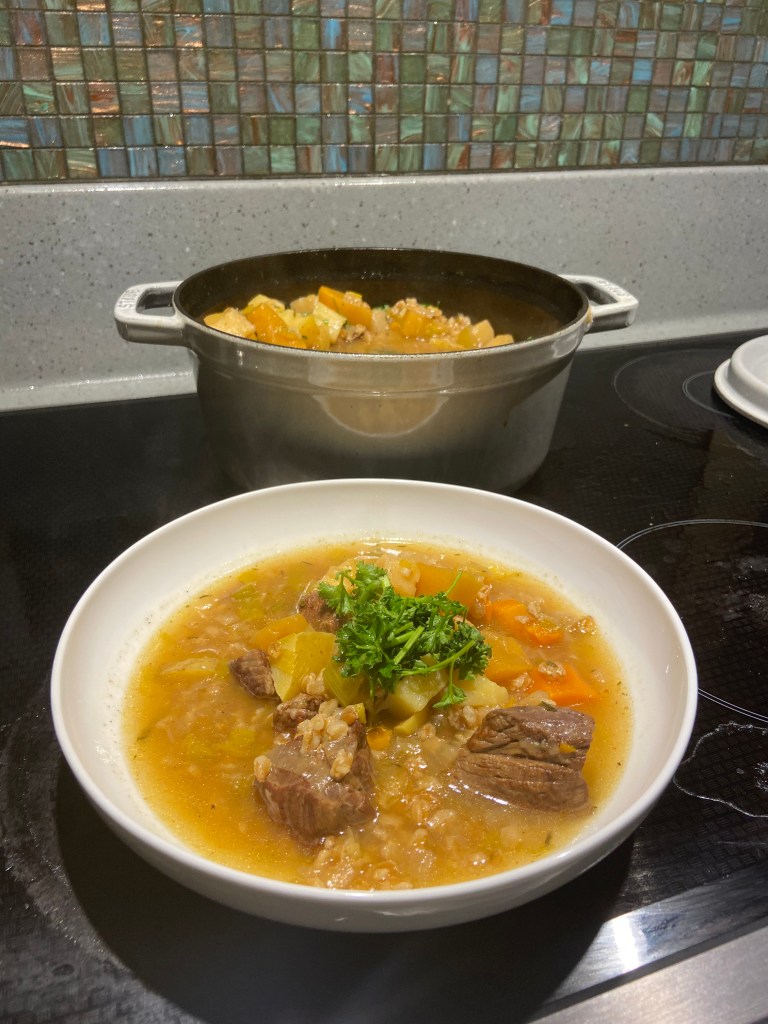
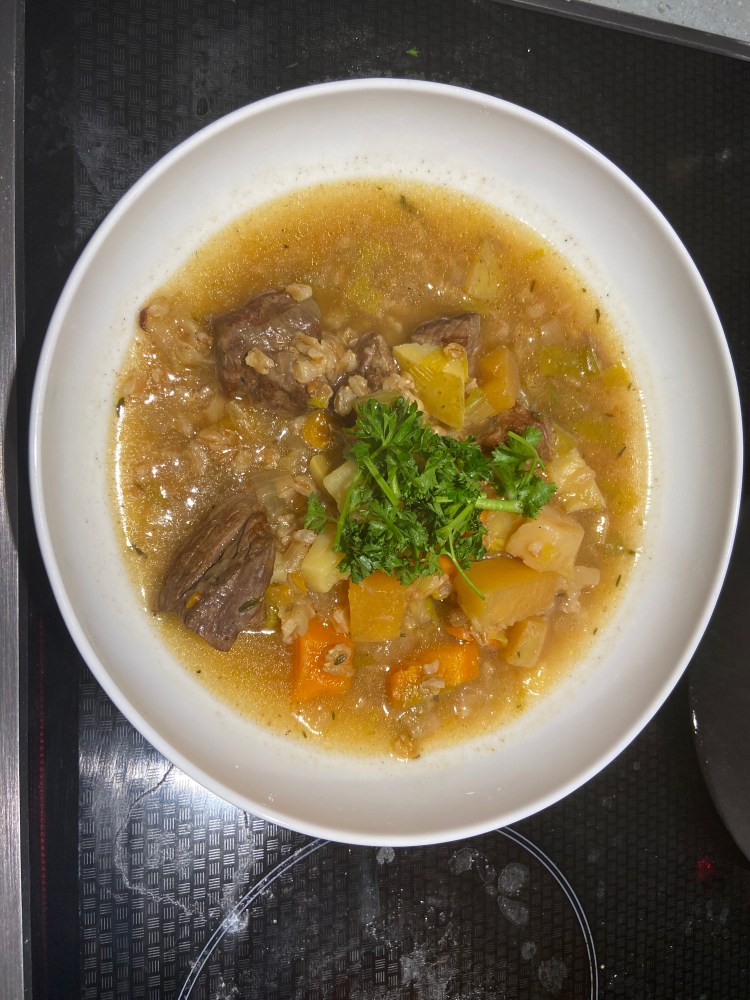
In a dutch oven — which side note, is one of my favorite utalitarian-esque, living-art, kitchen installments and mine’s grey — brown your chunks of lamb, sear all sides to trap maximum moistness, and then remove to a bowl or plate, use whatever’s clean. Then sauté your onions, garlic, celery, and leeks, and a few sprigs of thyme, impart that color like Coco Chanel introduced the fashionable trend of a little vitamin D to the un-pigmented masses. Incorporate a Little Rootie Tootie funk, yes listen to some blues while you cook but also add your root vegetables, cook until languidly softened with the smooth sounds of jazz.
Once sufficiently squishy, add your broth. The original recipe calls for lamb or chicken broth, admittedly I was an unwillingly and nescient basic chicken broth consumer, but I guess they’re milking broth out of everything these days, including lambs and cashews. Simmer concoction for as long as you need, I simmered for about two and half hours. The meat chunks should separate with a tender fork poke, I’d say that’s a good stopping point.
At this point, add your potatoes and farro. Yes, farro. As with most recipe recreations, I can never find the correct edible elements which would have been barley, I suppose the luck of the Irish comes with practice. While at the store, I stood in front of the grain section and quickly googled a substitute grain for barley, I found farro, thanks to Gourmet Sleuth’s Barley Article (I am not affiliated with the aforementioned website or article). The two grains apparently act and taste the same, just carry on as you would. Let simmer for another indefinite amount of time or until you can spear your utensil through a potato without much force.
While pre-dinner cocktail consumption still occurring, dinner is a second priority in my household. Après-cocktails, prepare a hearty bowl of stew, and garnish with today’s three-leaf clover sprigs, parsley. Serve the stew as a side to your Guinness. Sláinte.
Edible Elements
- Lamb chunks – chosen and cut for stews, don’t ask, or do, we should all be environmentally conscience of the food we ingest
- Onions
- Garlic – chopped, dice, minced, it all goes down the same way
- Celery – strongly optional; I was centimeters close to omitting this element, but alas, I gave into the magical celery, carrot & onion base, or as professionals like to refer to it, mirepoix
- Carrots – large, it might take you too long to chop up all those baby carrots
- Parsnips – cubed
- Rutabega – cubed2
- Potatoes – cubed3
- Turnips – my happy mistake
- Thyme -whatever is your plenty, use more
- Salt & Pepper
- Leeks – there is no such thing as too much of this
- Lamb Broth OR Chicken Broth
- Bay leaves – 1 through 4; your leaves, or maybe mine, might be dinky
- Parsley – edible garnishes, bébé
- Farro OR Barley – it depends what your local grocer stocks
I’ll definitely recreate this recipe again and I may or may not promise not to tint the stew with green food-dye in the future. I’ll most likely lose the internal genetic battle to do so. No, but really, I’m tickled-green to finally and appropriately be able to celebrate the Irish and their, or I suppose our, culture without feeling tinges of appropriating guilt. Three-leaf-clover cheers for green, guinness, and the Irish lads and lassies out there!
Bain Taitneamh as do bhéile mo chomh-eipicures!
Citations
“Barley”, Gourmet Sleuths. March 16, 2021. https://www.gourmetsleuth.com/ingredients/detail/barley.
Standage, Tom. An Edible History of Humanity, Bloomsbury, New York, 2009. https://www.amazon.com/Edible-History-Humanity-Tom-Standage/dp/0802719910
Van Boven, Yvette. “Irish Stew”, Homemade – Winter. Stewart, Tabori, & Chang, New York, 2012. https://www.amazon.com/Home-Made-Winter-Yvette-Boven/dp/161769004X
 Edible Memoir
Leave a comment