Shoe. Shoo. No, no, Choux. A homophone if I ever saw one. You can’t wear it on your feet and there’s no need to bugger off, we’re talking about choux: edible, fluffy, versatile. Choux pastry, Pâte à Choux, can be used to create profiteroles, cream puffs, churros, beignets, and eclairs, amongst other yummy pastries. I’ve only attempted a couple of the aforementioned pastries, with a hope, a wish, and a loose plan to try the whole lot … we shall see.
Unsurprisingly, pâte à choux claims french origins (ahem, the name should be proof enough) with possible ties to King Henry II and Catherine de’ Medici ‘s 16th century French court, and court goers & shakers, more specifically a court chef who supposedly developed the first cream puff recipe. However, before the time of instantaneous global news, recipes were most often given credit to those that published first, even if they weren’t the original creator; plagiarism was not yet part of the vernacular (the word was introduced into the written language and possibly oral language in the early 17th century) plagiarism wasn’t commonly acknowledged or punished – so the question stands, when does a recipe become your own and only your own? Can you truly own a recipe when there are only finite variants of modifications? Even with a powerful patroness, such as a Medici, can one assume intellectual property for a list of facts and instructions that probably had its conception in an unknown time and place? But those questions are also for another time and place.
One evening, or I should say, one early morning around two, I attempted choux pastry, as it always seems to be around that time that inspiration and creativity assume control in my brain, many a projects have beginnings around that time; no one could argue that I am not a night owl. I was determined to try not just one, but two types of choux pastries: Churros and Cream Puffs. And not only did I attempt two pastries in the same night, I also gave myself a perhaps unnecessary and extra accidental challenge by attempting them simultaneously all at two in the morning – what could go wrong? (that could be read as hindsight or foreshadowing, you decide). My choux attempts were inspired and adapted from a combination of recipes from Sally’s Baking Addiction’s Choux Pastry recipe, NYT Cooking Cream Puffs recipe, and Cooking Classy’s Churros recipe, (I am not affiliated with any website, brand, or recipe mentioned aforehand). Three recipes into two attempts; I overcomplicated things for myself, obviously.
I skimmed through the aforementioned recipes, and in hindsight, I probably should have read them carefully and understood the role each ingredient plays in the pastry, but I’m headstrong and impatient, two characteristics that gives me a distrust in authority, derives from an avoidance of stultifying predictability, and makes me quite a rogue baker, but I digress. Learn from my mistakes and enjoy the mayhem.
In two medium sauce pans on medium heat, I began to melt the butter, it took a bit longer than it probably should have because I plopped the whole stick of butter into each respective pan (logically, I should have cubed the butter, or at the very least sliced butter, because apparently the more surface areas that touch the heat, the faster the butter will melt – but we all make decisions we only rethink in retrospect). In one sauce pan, I poured in one cup of water and in the other, one cup of 2% milk. Afterwards, a sprinkle of salt and a teaspoon of sugar was added into each pan. I did a little stirry-stir and then poured in a cup of flour, respectively, again.
This is when things take a turn for the strange. Choux is an odd pastry, one that must be “cooked” before its cooked. Although eventually destined for the oven or a vat of oil, the dough must wait until the flour has been cooked over the stove. Obviously, as the most logical next step, I did a little jig with the pan; alternately, I removed the pan off the heat and then placed it back over the heat in time chunks of about one minute. Simultaneously, and with a spatula, I stirred the flour, well sort of beat the flour… okay, more accurately, I forcibly smeared the flour into the sides of the pan to “cook” the batter. So back and forth the pan traveled, between the heated stove top and the cool counter top, with me continuously smashing and smearing the flour into the sides of the sauce pan, and maybe I was kind of dancing, you’ll never know for sure. Considering the time of the morning and because I was distractedly watching a Netflix (not affiliated) show while stirring, I probably could have stirred and cooked the batter until day-break (and since sunrise was somewhere near 6:30am, I didn’t have a terribly long time to stir). But I did stop stirring at some point, I chose an arbitrary stop time, well actually, I stopped when my arm became too tired, it was anywhere between three minutes to ten, only me, myself, and I know. Do what feels right to you, stir until just before forelimb soreness or after, it’s your life, your rules.
Once the batter was properly cooked, I plunked the batters, one turn at a time, into large bowls and allowed for a proper cooling time (maybe five or so minutes). The cooling time prevents any unwanted scrambling of the eggs from excessive and concentrated heat. As it was, I only had one egg left in the carton but nevertheless I carried on. Ladies and gents, read that last sentence again because that is where my folly begins. It may be the first oopsie but it shan’t be the last. This will not be a chapter of successes, but there’s no accounting for what the future holds. I moved the one, single egg from the refrigerator with the considerateness of handling a rare treasure, perhaps the approximate value of a fabergé egg, because by golly I didn’t want to drop the precious thing. Carefully cracking that one egg into a liquid measuring cup, I scrambled the yolk and white together, and one batter at a time, I poured the approximation of half that egg scramble into one choux batter at a time.
First Lesson Learned: Eggs are very important in this recipe. If you do not balance the eggs proportionately to the dry elements, the dough will be tough and dense. The eggs aid in the structure and rise of the choux. Eggs contain protein that stretches in the cooking process. The infamous hollowness inside choux comes from egg protein stretching and tearing. They also contain moisture that adds to the liquid that vaporizes in the oven to become steam and allows the choux to rise. Additionally, eggs are inherently creamy and naturally flavorful, creating a soft, interior texture & golden-brown outer appearance.
That precious egg was whisked, well as gently as any electric powered mixer can beat an egg, but whisked, it was. I had only this one shot, or I suppose two shots, to mix together the batter, well batters. And unfortunately, I knew seconds into whisking the first half an egg into the first batch, that the choux was never going to reach fruition. The batches were duds. The liquid, a.k.a. the egg, in the batter would not proportionally balance the already cooked choux dough, and since the whole recipe was already “cooked” over the stove and there wasn’t any other elements that needed to be added, the egg was a make it or break it element. It obviously was a break it element. What’s that saying? You have to crack a few eggs to make an omelette? Well I learned that I have to scramble more than one egg to make some choux. Thus, I had to relinquish my dream for fluffy cinnamon-y cylindrical tubes and puffy cream-filled early-morning treats, because the batters would explicably miss their marks, their destinies as indulgent sweet desserts would ultimately fail. Despite all of that negativity, or dose of reality, I thought I could work the batter enough to make it all work. I seized my spatula and turned-over the choux batter, folding and folding, searching for that infamous “v-shape” the batter is supposed to make as it falls off the spoon, or spatula in this case, but alas, it wasn’t my night…morning…night (since I had yet to “go to bed” yet, logic follows that it was still night, just not my night). Notwithstanding, I still had one (egg), fool-hardy spoon-fall of a hope.
I equipped myself with that spatula (the one from earlier) in one hand and a plastic, resealable bag (I bought some reusable, silicone piping bags, they are currently in the mail so I have to make do whilst I wait…wait only semi-patiently, I might add). With the spatula, and a hope and a prayer, I scooped the entirety of the choux batters into each respective resealable plastic bag and then snipped off each tip. Let me tell you, those bags were not made with the intent to use them as piping bags, weak from every sealed edge and seam, the bags were practically made to explode from pressure, but more on that later. From this point on, the two batters would be destined for two different flavor and patisserie futures, well so says Nostradamus.
Cream Puffs
I preheated the oven to about 325°F, as for why, I could not say. With the baking sheet properly blanketed with a silicone baking mat, gently squeezing those resealable plastic bags, I portioned off a baker’s dozen + 1. I then popped the fourteen pre-destined puffs in the oven for an indefinite amount of time. And thankfully, I already knew from way too many repeated binges of “The Great British Baking Show” (not affiliated), that one is never supposed to open the oven mid-choux bake, but I’m not even sure if a little air would have worsened my already visibly atrocious puffs, but alas, I kept the oven shut.
Second Lesson Learned: Courtesy of “The Great British Bake Off”. Do not open the oven at any point during the baking & steaming process. The water and other liquid in the dough, and the water sprinkled atop the baking sheet, aid in the rise of the choux. The water evaporates in the oven, creates steam, and gives the choux its notable “puff”. You must never open the oven in the midst of baking, even to check your progress. Once opened, the steam will leave the oven causing the choux to not rise properly and you’ll have to start from the beginning again.
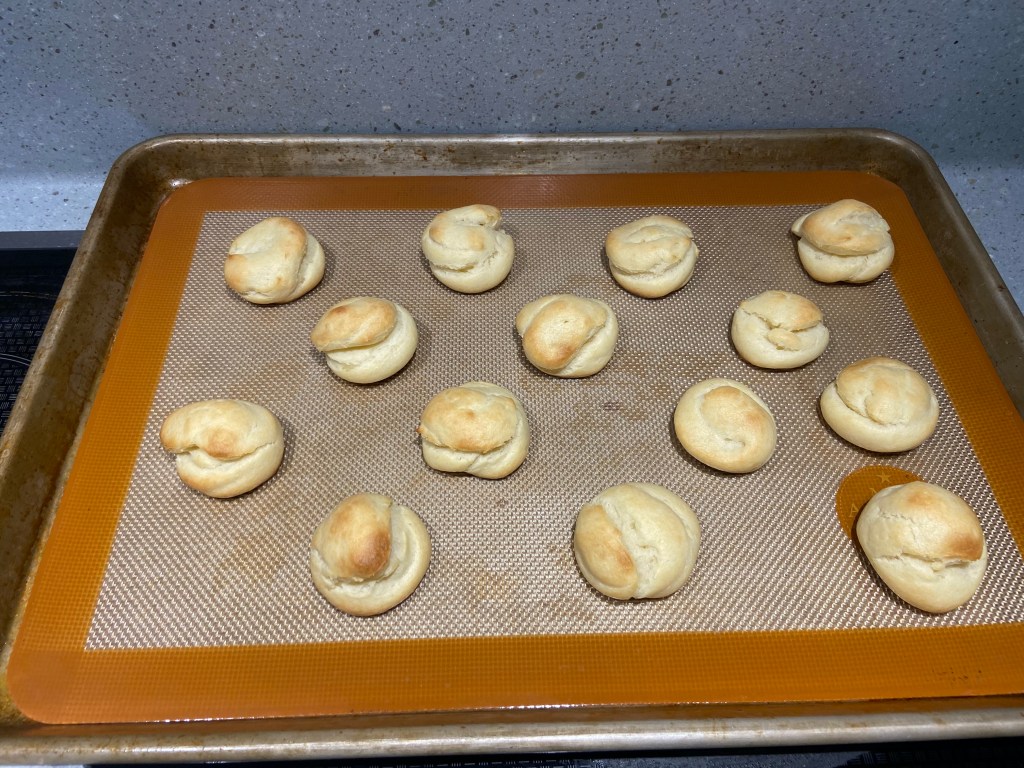
Forgoing any regrettable or idiotic mistakes, I kept the oven closed. And thanks to oven lights, I didn’t need to open the oven to have a first row seat to puffs not rising. As predicted, my puffs weren’t puffing, due to probably a few factors. However, despite the no “egg wash”, I couldn’t fault my puffs for not browning. Actually, I learned, the use of milk helps the puffs brown. The use of only milk in the choux perhaps an unnatural and premature browning to the surface of the puff.
Third Lesson Learned: The use of milk, in the choux dough, gives the finished pastry a golden brown crust, whereas the use of water provides a fluffier and lighter interior to the pastry. And a mixture of the two, milk and water, will impart both a fluffy interior and a golden exterior.
Some indeterminate time later, I removed the puffs from the oven. If it wasn’t obvious through the barely transparent and mostly opaque oven doors, and my previous elucidations, the puffs didn’t puff. After letting the puffs cool, I picked one up and immediately felt the heft of the interior, which from past cream puff eating experiences, puffs are not supposed to posses a heavy weight. In addition to a heavy interior, the exterior was frankly malformed. Globular and lumpy, the puffs lacked a bit of a je ne sais quoi. And although physically and texturally incorrect, the flavor was there and that gave me hope in a puff-less place. Due to the heft of the puff, when I bisected the pastry, there was no hollowness, basically no room to put any of the cream to make the cream puff. Due to the lack of real estate in the puff for whipped cream, I decided to do without the whipped cream on this round of puffs, this won’t be the last time I attempt cream puffs.
Somewhere between placing the puffs in the oven and removing the not-so-puffy puffs, I attempted frying the churros, below. Not literally below, just virtually below. Scroll down.
Cream Puff (In)Edible Elements
- Flour – 1/2 cup
- Butter – unsalted, 1/3 cup
- Sugar – granulated, 1 tsp
- Salt – a sprinkle
- EGG-1/2 (There definitely should have been two eggs, or at the very least one whole egg, but c’est la vie)
- Milk – 2%, 1/2 cup
Churros
While the puffs were in the oven, it was time for some cinnamon-y goodness. In one of those medium-sized sauce pan from earlier, you know the one, the one we already used to cook the choux, I filled it with some oil. I chose vegetable oil, first, because it’s notable for all types of deep-frying shenanigans, and two, this was the only oil, apart from olive oil, I had in my pantry that evening. I’ve deep-fried a handful of doughs and batter in my day, Banana Doughnuts included. Since I’ve accumulated this handful of experiences, with some recipes that don’t require a precise oil temperature, I believed I could transfer this expertise unto these churros, unfortunately, my hubris caught up with me.
Fourth Lesson Learned: Invest in a thermometer. Invest in a candy thermometer that withstands and is made for frying oil. I dare say, it doesn’t need to be the most expensive, just invest in one, even if it’s a small investment.
Remember that resealable plastic bag filled with batter, no the other one, the one we didn’t use to squirt out weird puff globules on a baking mat, the one we made with the churro (in)edible element list. Although a regular tip was welcomed for the cream puffs (courtesy of a straight-cut on the plastic bag), I do not own piping tips, therefore I could not and did not use piping tips (most noticeably missing from my non-existent piping tip collection, the characteristic churro star-shaped piping tip). Once the vegetable oil reached what I believed to be an appropriate deep-frying temperature, I squirted in tubes of nondescript churro batter from my makeshift piping bag, and with some kitchen scissors, I cut the batter as it slowly flowed from the plastic bag. The little nuggets of churro batter didn’t fall quite gracefully into the oil, they spiraled in on themselves and formed semi-circles and squiggly shapes, inevitably forcing me to accept that I would not create the perfect linear churro. Moreover, after only three squeezes of the plastic bag, the seams burst, and churro batter started spewing from four points of egress. Which, depending how you view the world and see this experience, when I squeezed the bag once I got five tiny churros spurting out or when I squeezed the bag once I got five tiny churros spurting out, read that as you will.
Well since I didn’t bring the oil temperature to any recipes’ required frying temperature, the frying-times given by the recipes for how long one must deep fry those little batter nuggets was basically moot. I allowed the little churro nuggets to bathe in the oil hottub until well they started changing color; I was waiting for that perfect golden brown. I’m not saying that every churro achieved that perfect tan, but they were mostly in the same ball park, perhaps more egg would have aided in the browning, but the hot oil and deep-fry did the trick this time around. Despite an all-around even tan on the group, some didn’t necessarily cook all the way through on the inside. And when I say “didn’t necessarily” I mean, they were undercooked. Brown on the outside, mushy on the inside. If I had to choose, I would have rather had some pale churros that were fully cooked, but you can’t have it all. While the churros were simmering in the oil, I mixed together some sugar and cinnamon on a flat plate. When I scooped the churro out of the oil, I immediately rolled and coated the little misshapen nuggets in the sugar and cinnamon mixture. To be honest, the first few were not immediately coated in the sugar and cinnamon, I actually placed the oily little critters on a paper-towel coated plate to soak up said oil and, unfortunately, removing the hot oil actually removed the binding element for the sugar and cinnamon. Wherefore, the first few nuggets were, in no uncertain terms, naked little deformed choux puff churros. I learned after a few that the sure-coating way was to plop those piping-hot misshapen nuggets directly onto the plate filled with cinnamon and sugar, allowing the oil to mingle with the sugary mixture and create that infamous churro coating. Those of the bunch that sported that perfect golden brown, were surprisingly fried all the way through, and had the luck to be directly dipped into the sugar and cinnamon mixture, although physically distorted, were quite delicious. My problems obviously were numerous, however, I don’t think the lack of eggs effected the outcome tremendously, I actually believe that my lack of the proper instruments, such as the thermometer, piping bags, and piping tips, detrimentally skewed my churro results toward the ugly and undercooked.
Fifth Lesson Learned: Invest in some piping bags. I know you probably already own some resealable, plastic bags, and sure they are wonderful for sealing away leftovers, but leave the squeezing to the experts. I suggest investing some capital into some piping bags purposefully created for your culinary and patisserie needs; piping bags created with the intent to be squeezed, pressurized, and filled with partially pliable solids. My cream puffs and most definitely my churros, would have appreciated some dependable piping bags. Do the earth a solid and invest in some REUSABLE piping bags; they are good for the planet, durable, and easy on the wallet. My reusable, silicone piping bags are in the mail, as I type this, so hopefully in the following chapters I can give you an honest review.
Although there may be one photo that clearly shows my cream-puff puffing failures, the unremarkable churros were mistakenly, entirely, and pixelly ignored therefore no picture exists to prove just how unremarkable the churros actually were. Although quite ugly, the churros were damn tasty, so let your imagination run wild, well not too wild, think Georges Braque, geometric and out of the box.
Churro (In)Edible Elements
- Flour – 1 cup
- Butter – unsalted, 1/4 cup or more
- Sugar – granulated, 1 tsp
- Salt – a sprinkle
- Eggs – 1/2 (well however much egg you have leftover after the first batch for the cream puffs)
- Water – 1 cup
- Cinnamon
- Granulated Sugar
So in all, both choux attempts resulted in some pretty, ugly finished pastries. Both flavorful, yet malformed; browned, yet bulbous; heavy, globular, and misshapen. It was an experience, one that opened the pastry door into the world of choux. I’ve only just begun experimenting and dabbling with choux pastry and I look forward to attempting the other types of choux. Keep your eyes open for more, possibly imperfect choux pastries in the chapters to come.
Okay, I’ve used the word “ugly” quite a few times in this chapter, but I suppose beauty is in the eye of the beholder, or should I say stomach of the beholder.
1 Last Egg + 2 New Recipes + 2 a.m. Shenanigans = 5 Lessons Learned in the Process.
Bon appétit my fellow epicures!
Update: I took a deep breath before I tried Cream Puffs again, approximately a week-long breath. And now I have finally perfected the balance of water to milk, and not to mention, provided the proper spotlight for the eggs, in my recipe and rendition of The OG Cream Puff. Hey, I told you I wasn’t done with the cream puffs. Maybe I’ll have a go with Churros … pronto.
Citations
“5 Historical Moments that Shaped Plagiarism: Plagiarism since the Dawn of Language,” Turnitin, January 29, 2019. March 12, 2021. https://www.turnitin.com/blog/5-historical-moments-that-shaped-plagiarism
Grunert, Jeanne. “History of Cream Puffs,” Love to Know. March 12, 2021. https://gourmet.lovetoknow.com/History_of_Cream_Puffs
Jaclyn. “Churros,” Cooking Classy, September 2, 2018. March 11, 2021. https://www.cookingclassy.com/churros/
Kafka, Barbara. “Cream Puffs Recipe,” NYT Cooking. March 11, 2021. https://cooking.nytimes.com/recipes/11789-cream-puffs
Sally. “Choux Pastry (Pâte à Choux),” Sally’s Baking Addiction, September 3, 2018. March 11, 2021. https://sallysbakingaddiction.com/choux-pastry/
 Edible Memoir
Leave a comment