An obvious oversight in my culinary repertoire, I tried my hand with homemade pasta. My gluten-loving heart had to commemorate the first experience herein this chapter.
Surprise surprise, I don’t own a pasta maker. But you know what I do own, two arms, two hands, and a heavy-duty metal rolling pin. And you tell me, what’s more badass than rolling out your own pasta. I am Vesta, goddess of the hearth, virgin pasta-maker and shattering those misguided illusions that only tiny nonnas are capable of producing some earth-shattering pasta dishes.
Vesta the goddess of the hearth and home, amongst a few other things, (ahem, virgins), remained eternally chaste and was honored at every family’s hearth fire. She made the decision to become the eternal virgin, a symbol of purity and of female strength, her decision probably becoming one of the first feminist acts. Forever vigilant and watchful, over all women, virgins and non-virgins alike. Throughout history women have been connected with symbols of fertility and new birth, such as the egg. The Romans even believed the egg also represented new beginnings. Such a powerful symbol had no difficulty emerging in the cuisine of the locals. And sheesh was this a new beginning for me, into the foray of pasta making.
Unlike Vesta the eternal virgin (of pasta making, joking), I have not remained chaste and have delved into the eggy-underbelly of the pasta-making world, and I’m hooked. This type of culinary expertise doesn’t require an exact guidebook thus it’s a kneads based assignment.
I have to admit, squishing nostalgic, playdough-like elements (that are actually edible), reminded me to enjoy the small, messy moments when adulting isn’t and shouldn’t be a priority. Remember when you’re in the kitchen or sitting at your dining room table kneading out pasta dough, remember to be present and lean into the mess, your apron should catch all the rest.
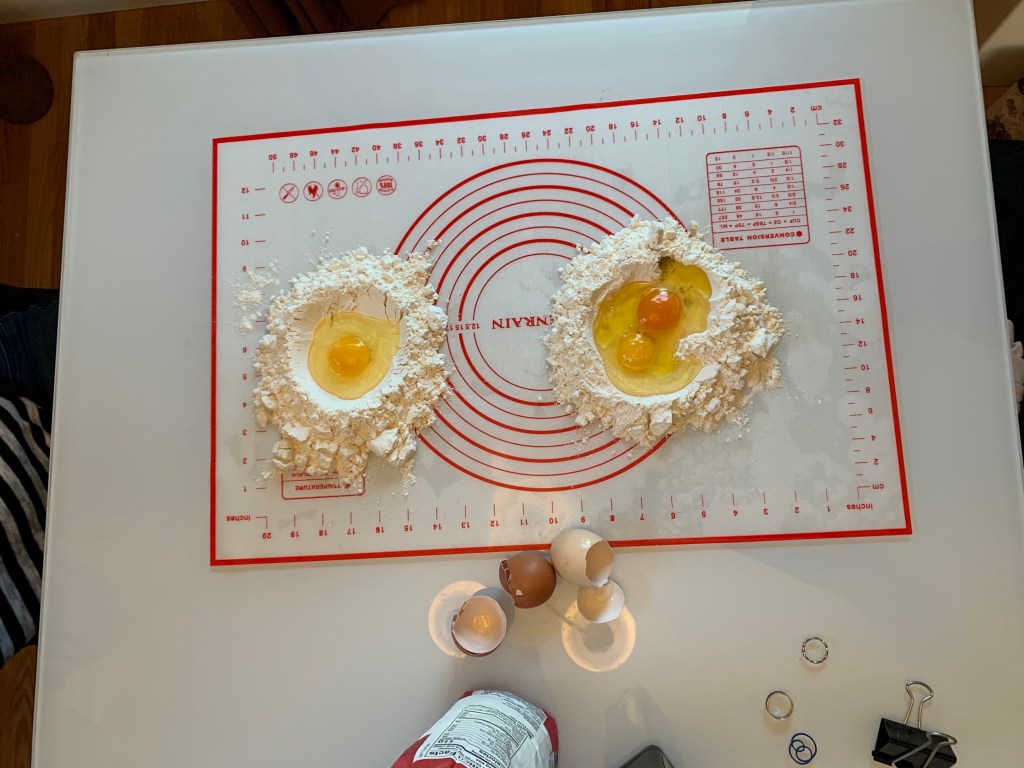
A large space on my table to do the dirty (work).
A large baking mat.
A bag of all-purpose flour.
A carton of eggs.
A bottle of olive oil.
A shaker of salt.
I prepared pasta with a friend of mine, hence the two piles of flour pictured above, the both of us pasta-making virgins before that evening. On the mat, we formed little hills of flour, dug little ditches for the eggs, and drizzled a bit of olive oil, creating a gloopy mess that we began to knead. I forgot to add the salt until the end.
In hindsight, I should have sprinkled in that bit of salt prior to the start of kneading, but alas, t’was a learning experience. It was difficult to incorporate the salt into fully formed pasta orbs and most likely hindered the gluten formation in the dough. Adding the salt towards the end of the kneading process didn’t allow the salt to fully incorporate and I ended up not kneading the dough WITH the salt for a long enough period to get those gluten pistons firing. A mistake made on my side of the computer and an easy lessoned learned on your side.
The aforementioned egg introduces a creamy element and aids in the gluten structure of the pasta as a whole. The egg whites make the pasta pliable and creates the actual protein structure that holds your culinary project together. The yolk, which is the fattier part of the egg, gives the pasta a bolder, deeper flavor. Additionally, the yolk gives a yellow coloring to the pasta, thus the more yolks you use, the more yellow and dense your pasta will be. Both the yolk and the white of the egg add moisture to your pasta dough.
I kneaded that dough ’till I could knead no more. As I kneaded, I could feel the elasticity growing and stretching and approximately 30 minutes past the initial knead, I stopped, rolled the dough into a tight ball, and wrapped it in plastic wrap. I then let the little dough ball sit unattended to grow-up all on it’s own for an additional 45 minutes (at least).
Balled and properly gluten-ized, it was time for me to use my goddess-given pasta-makers. On the same mat as earlier, flour the surface generously, and one at a time, roll out the dough balls until flattened to your desired pasta thickness.
The process, of rolling out the pasta dough, occupied a larger portion of time than I had previously allotted, therefore, we ate dinner like Romans that evening, late because of my mid-day siesta and because of the lack of a pasta-maker, but it was worth it. Just like my mama always tells me, “if you’re tired, nap, it’ll all be there when you wake up,” she’s a wise woman and a Roman at heart, obviously.
I could tell you the number of rolls required to reach that desired pasta thickness, but I think the total number would send you into shock. Just turn on some music, or talk to that friend helping you make that pasta, or just switch off your ability to think critically at all and mentally zone out for a moment.
It’s worth noting, you could substitute kneading by hand with kneading the dough in your KitchenAid mixer (if you’re lucky enough to own one). And you could buy a pasta maker (or pasta maker attachment) to shorten and simplify the rolling process even further, and save your arms for another day. However, as I wrote earlier, anything worth doing is usually pretty difficult. After making my own pasta at home, I have a newfound appreciation for fresh, homemade pasta from restaurants and will continue to appreciate homemade pasta when I dine-in at restaurants in the future. It’s hard work but learning the fundamentals has been pricelessly educational. I cherish learning whenever I can find a new opportunity to do so. Just try it once, it’ll be worth it. There’s something about making and eating pasta the way the ancient Roman gods and goddesses would have, it’s empowering and respectful.
Parppadelle was the chosen pasta shape for tonights dinner. Less moulding due to it’s wider strand yet stringy enough to hide all of your pasta-making mistakes, hence parppadelle was a no-brainer. However, who am I to dictate your pasta-makings shapes. You can mould those weird globs, cut out some irregular lines, or roll out some strange tubular shapes; this is a judgement-free zone. Just remember to re-flour the surface and pasta strands, globs, or shapes continuously; you don’t want them to stick together or maybe you do (to each their own). The extra flour dust from the pasta shapes will mix with your pasta water when cooking, creating that flour-y water you need to produce that perfect sauce later. You can also toss the uncooked pasta, well floured, into a plastic, resealable bag and store it in your fridge or freezer until you’re craving some pasta.
In the meantime, boil a pot of water, salt it generously, and when it begins to bubble, toss in your pasta. Cook until desired doneness. Fresh pasta will cook faster than you can say, Andiamo! Again, I’m in the al dente camp, but it’s your pasta. When you decide the pasta is done, toss it with your favorite sauce, or eat it out of the pot, it’s your decision, your life, however, it may be difficult to host a dinner party with one pot and eight forks.
Semi-Pro Tip: After cooking the pasta, the water still in the pot should now have an ethereal, cloudy appearance — this is the extra flour that floated off your pasta strand to mix with the water. This flour-y water is crucial. The flour (gluten) has now properly mixed with the water thus giving you the perfect thickening agent that does not clump. It will thicken any sauce, as if by magic. The flour-y water helps any sauce stick to your pasta strand, even an olive oil based sauce. SAVE THE WATER! You might ask, if I can’t drain the water in my colander, what do I do? Use a slotted-spoon, a pronged-laddle, tongs, or even a massive fork, anything short of using your hands.
The beauty of making your own pasta are 1) no rules, 2) a space for creativity, and 3) everything is YOUR decision, not mine, and not that faceless chef in the back of a restaurant believing they know what’s best for your stomach. You decide how much pasta you want to eat, you decide if maybe you want to add a minced herb or vegetable into the pasta dough, or maybe you want to ignore your lactose-intolerance instincts and smother your pasta in cheese, it’s your decision. Own your decision. Be like Vesta and control your destiny, embrace that goddess within.
No, but actually, what feels like an eternity ago, I spent some time in Rome, visited a view monuments, and consumed an incalculable amount of food. Pastas, pizzas, and wine, oh my! Bacchus surely appreciated the many nights I drank in his honor. Natheless, while marveling at the beautiful people and food in Italy, I too, devoured some historical knowledge, courtesy of my zany, history professor. The Roman forum features the ancient Roman city center, including the Temple of Vesta adjacent to basically an apartment building to house all of her Vestal Virgins. They would live as eternal virgins stoking Vesta’s eternal hearth (not kidding, that fire couldn’t die, if it did, there would be some insane punishments) until the end of their youthful days, when a new, young virgin would take her place. Let’s have a moment to reflect in silence on how fraternally and patriarchal centered society ancient Rome was and why feminism is important.
I’d love to take this space and platform to highlight the extreme irony that, historically, women (or a woman, more specially Vesta) have literally been stoking the eternal hearth (the modern day stove in the kitchen) since the dawn of time, or at least the dawn of Roman gods, yet today women only make up 24% of chefs in America and only 7% are head chefs and restaurant owners worldwide. Irony abounds in a woman-stoked kitchen, in a man’s world.
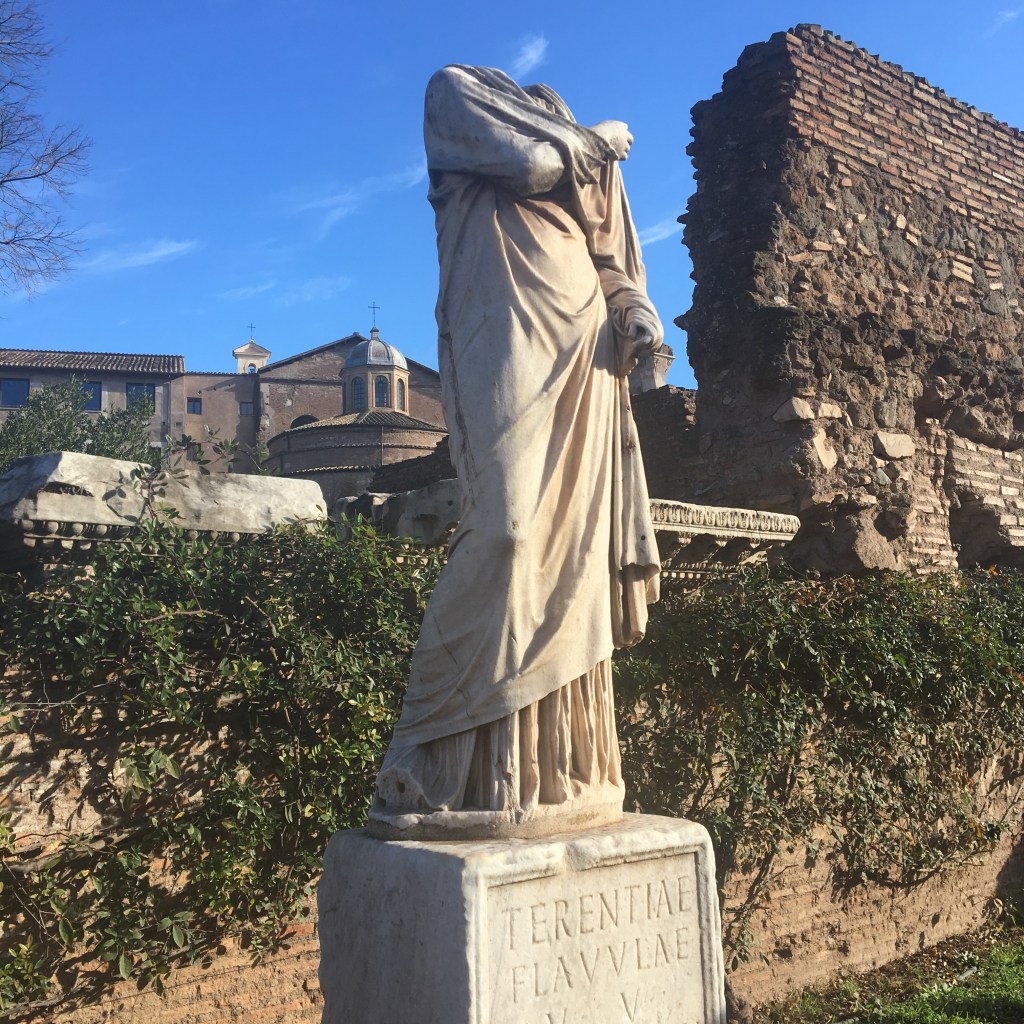
Just as Vesta was swallowed whole by dear old dad, Kronos, you too can consume the power of a Roman goddess … in the form of this pasta dough. Just remember to appease, leave offerings, and make a few sacrifices (most likely sacrifice – the ability to move your arms comfortably the day following dough rolling, trust me). On Vesta’s behalf, I will take bowls of pasta as payment, grazie.
LIFE UPDATE: I have acquired a KitchenAid Stand Mixer (not affiliated with the brand or product) but have yet to use it to knead my pasta dough. There has been no desire to forgo the traditional way, as of yet.
Edible Elements
- Flour – all-purpose, you can get fancy if you’d like with others but I’m as casual as the PNW ; about 1 cup, and a bit to dust your mat, you can always add more if your eggs are of a particularly juicy variety
- Egg – about 2 if you’re making pasta for two; you can do a mix of whites and yolks, it’s your decision
- Olive Oil – a drizzle
- Salt – a dash
Citations
“7 Percent of Head Chefs and Restaurant Owners are Women”, Center on Halsted, August 7, 2019. May 25, 2021. https://centeronhalsted.medium.com/7-percent-of-head-chefs-and-restaurant-owners-are-women-2f26b3ea38bc
Madeleine, “Who was Vesta, the Goddess of the Hearth,” THEOI GREEK MYTHOLOGY – Exploring Mythology in Classical Literature & Art, September 13, 2019. October 6, 2020. https://www.theoi.com/articles/who-was-vesta-the-goddess-of-the-hearth/
Maranan, Victoria, “US Census: Women make up less than a Quarter of Chefs”, Spectrum News 1, February 3, 2020. May 25, 2021. https://spectrumlocalnews.com/tx/austin/news/2020/02/03/u-s–census–women-make-up-less-than-a-quarter-of-chefs
The Editors of the Encyclopaedia Britannica, “Vesta: Roman goddess,” Britannica. October 6, 2020. https://www.britannica.com/topic/Vesta-Roman-goddess
 Edible Memoir
Leave a comment